

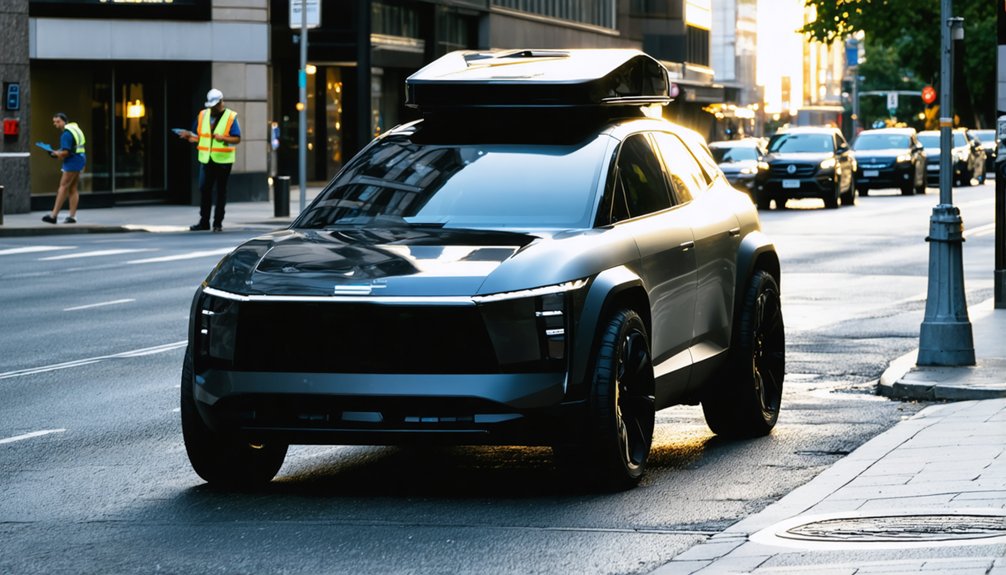

You’ll see small fleets mapping routes, with trained drivers and remote supervisors testing in diverse cities—from Vegas to San Diego, Tokyo and wintery UP roads—to validate safety across climates and driving cultures. Regulators vet emergency plans, sensors, and permitting while NHTSA updates standards for vehicles without manual controls. Cities require public outreach, insurance proof, and local protocols. Operators track miles‑per‑intervention, collision rates, and energy use. Keep going and you’ll get the full picture of rollout, rules, and community impacts.
Key Takeaways
- Pilots run small, controlled fleets in select urban zones to collect data while gradually expanding coverage and complexity.
- Tests combine manual drives, trained specialists, and sensor mapping to build high-resolution, city-specific maps.
- Safety oversight uses safety drivers, remote supervisors, and layered performance metrics (miles per intervention, collision rates).
- Regulators require permitting, emergency plans, insurance, and technical reviews, with federal NHTSA pathways for nontraditional controls.
- Community engagement and local partnerships guide scenario selection, transit integration, and equitable deployment priorities.
Where Testing Is Happening Now
Waymo’s self-driving tests are spreading fast: you’re seeing cars roll into places like San Diego, Las Vegas, Truckee and Michigan’s Upper Peninsula, with upstate New York and even Tokyo included in its broader footprint.
You watch small fleets—fewer than ten vehicles per new city—begin with manual drives through busy downtowns while trained specialists map routes and gather data.
That careful rollout helps shape public perception as locals witness gradual, safety-first shifts to autonomy.
You feel invited into a shared journey where academic partnerships and local feedback guide testing in varied conditions—from Vegas Strip complexity to Upper Peninsula winters.
You’re part of a community watching months-long progress toward more autonomous operations and broader deployment. Recent announcements indicate Waymo plans to expand testing to more than 10 new cities in 2025. Waymo is also starting with small fleets in each new city as part of its expansion plan. Advanced analytics are being used to analyze test data and improve performance.
How Regulators Approve City Trials
When cities consider allowing self-driving car trials, regulators first require a detailed application that proves safety systems, emergency response plans, and vehicle design meet state and federal standards—submissions get an initial completeness check before moving to technical review.
You’ll see technical reviewers assess autonomous capabilities, compliance with state rules, and required documentation; some states demand granular disengagement reporting or minimum safe miles before approval.
Permitting timelines vary by state and pilot complexity, and NHTSA’s AV STEP can streamline federal exemptions for nontraditional controls. The agency’s new framework aims to modernize FMVSS. Local regulators also often ask for evidence of industry coordination to ensure consistent safety practices across jurisdictions.
Cities expect operators to include public engagement plans, insurance and bonding proof, and tracking methods so local authorities can monitor permits.
You’ll be part of a transparent process that balances innovation with community safety.
NACTO’s submission supports enhanced reporting requirements and involvement of local governments in AV oversight.
Vehicle Safety Requirements and Protocols
Because driverless designs change how a car is controlled and sensed, regulators are updating safety rules and establishing clear operational protocols to make sure automated vehicles perform reliably on public roads.
You’ll see federal updates modernizing transmission, start/stop, windshield defogging and wiper requirements, and revised headlights, taillights and other lighting standards to fit AV designs. FMVSS still apply, but NHTSA’s regulatory exemptions let makers sell limited numbers while adjustments are made. NHTSA is also pursuing three rulemakings to modernize FMVSS for vehicles without manual controls.
The Automated Vehicle Framework sets measurable performance metrics—accidents per million miles, visibility, environmental behavior—and prioritizes safety alongside innovation. Recent federal guidance also aims to create a single national standard to reduce regulatory fragmentation.
States are aligning laws and registration rules so you and your community share transparent expectations for AV behavior and accountability on city streets. Recent state actions reflect this trend, with several jurisdictions enacting driverless-vehicle laws.
Early-Stage Fleet Operations and Human Oversight
Although still limited to specific zones and cautious rollouts, early-stage robotaxi fleets are already shaping how cities will manage oversight and human fallback controls.
You’ll see fleets like Waymo’s 1,500+ vehicles operating in set zones while other firms expand incrementally, and you’ll feel reassured knowing safety drivers remain in many tests.
You’ll also rely on remote supervisors who monitor multiple vehicles, ready to intervene when sensors or software encounter novel situations.
Cities are learning to coordinate permits, mapping, and hub integrations so you and your neighbors share trustworthy services.
As fleets scale from tens to thousands, your voice in community feedback will guide protocols, ensuring oversight balances innovation with local safety expectations and equitable access.
Waymo–Uber tie‑in enables hailing some driverless vehicles through major ride‑hailing apps, improving accessibility.
Measuring Performance and Safety Outcomes
Now that fleets are operating under human oversight and remote supervision, cities and operators need clear ways to measure how those systems actually perform on streets. You’ll rely on layered performance frameworks—collision avoidance rate, miles per intervention, lane keeping accuracy, and energy consumption per mile—to judge progress.
Use real-world monitoring like TrafficZoom dashboards and high-resolution speed feeds to track travel time, LOS, vibration levels, and network bandwidth impacts. Integrate standardized protocols: stop sign adherence, reaction times in milliseconds, and multi-object avoidance into an Autonomy Performance Matrix.
Don’t skip sensor calibration checks and behavioral validation against human-level benchmarks and near-miss analyses. Together these metrics shape inclusive, accountable deployments you can trust and help improve.
City-Specific Challenges and Learning Curves
When cities vary in climate, road design, and driving culture, your testing program has to adapt rather than assume one-size-fits-all performance. You’ll face climate limits—Phoenix heat won’t teach you Detroit snow—and must supplement with simulations for rare fog or heavy rain.
Infrastructure quirks like trolleys, narrow streets, faded lane markings, and unique signal signage force continuous mapping and city-specific scenario catalogs. You’ll also need behavioral datasets that reflect local cultural norms: jaywalking, aggressive merging, or festival crowds change risk profiles and require tailored prediction models.
Regulatory patchworks and public skepticism mean you’ll work with different geofences and acceptance strategies. Learning here isn’t optional; you join communities by iterating with local data, regulators, and residents to make AVs fit each city.
How Testing Shapes Future Urban Mobility
Because testing exposes how AVs actually perform in cities, it shapes the policies, street designs, and services you’ll see in the next decade.
You’ll notice signals from safety impact testing — fewer fatalities, better reaction times, and vehicle-to-vehicle communication — inform stricter regulations and redesigned intersections.
Traffic flow and parking studies guide reallocating lanes and reclaiming curbside space for people, parks, and commerce.
Community engagement during pilots lets you help prioritize transit connections, ensuring AVs complement public transport rather than replace it.
Behavioral adaptation—how people change travel habits when shared AVs lower costs and wait times—steers service models and subsidies.
Together, evidence-based testing and inclusive participation make future urban mobility safer, greener, and more equitable for everyone.
Plans for Expansion to New Cities
Having seen how pilots shape street design, safety rules, and service models, the company is scaling its on-road experiments: it confirmed in February 2025 an ambitious plan to test in more than 10 new U.S. cities throughout the year, starting with Las Vegas and San Diego and reopening operations in Washington, D.C.
You’ll feel included as the rollout targets diverse driving cultures to validate the Waymo Driver across varied urban landscapes. The road-trip assessment prioritizes safety performance and reliability while data guides local adaptations.
Production growth—from 1,500 active vehicles to 2,000 more I-PACEs and a Mesa plant with Magna—supports faster deployment.
Your city can expect deliberate community outreach and strengthened market partnerships so tests reflect local needs and build shared confidence.
References
- https://www.youtube.com/watch?v=K3ZaMB9TXwE
- https://www.latimes.com/business/story/2025-08-25/new-york-city-allows-robotaxi-company-to-test-autonomous-vehicles-in-manhattan-and-brooklyn
- https://www.iotworldtoday.com/transportation-logistics/waymo-to-test-self-driving-taxis-in-10-new-cities-this-year
- https://time.com/collections/time100-companies-2025/7289599/waymo/
- https://abc7ny.com/post/waymo-begin-testing-self-driving-cars-manhattan-downtown-brooklyn-mayor-adams-nyc-dot-announce-approval/17613834/
- https://www.autobodynews.com/news/waymo-to-expand-self-driving-testing-to-several-cities-in-2025
- https://www.deloitte.com/us/en/insights/industry/public-sector/autonomous-vehicles-deployment-in-cities.html
- https://waymo.com
- https://www.hks.harvard.edu/sites/default/files/It is Time to Change the Autonomous Vehicles Regulatory Approach 10.15.24 w.o Borders.pdf
- https://nacto.org/latest/letter-cities-deserve-a-say-in-av-step-autonomous-vehicle-regulations/