

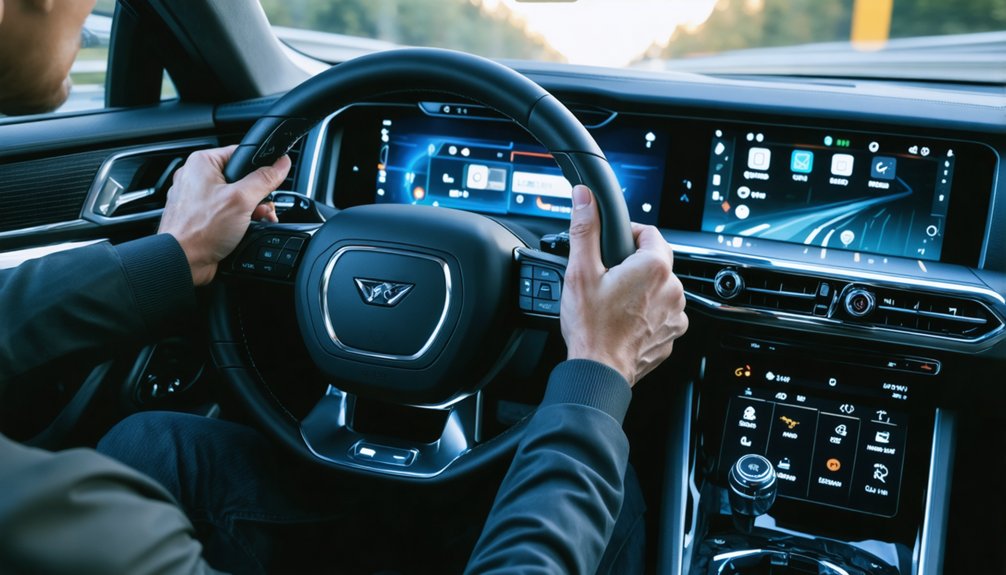

You’ll want to know whether a system is assistive (ADAS) or autonomous, because assistive features like ACC, lane-keeping, and AEB still need you to watch and be ready to intervene. Learn what sensors the car uses, how ACC gaps and braking strength behave, and whether lane-centering or highway assist will nudge or steer continuously. Check blind-spot, rear cross-traffic, and night-detection limits, and match features to your driving — keep going for fuller guidance.
Key Takeaways
- Identify the system type (ADAS vs. autonomous) and its SAE level to know how much driver attention remains required.
- Check which sensors (camera, radar, lidar, ultrasonic) the feature uses and their known weather and night limitations.
- Understand longitudinal functions: ACC manages speed/following distance while AEB and FCW provide collision warnings and automatic braking.
- Review lateral features: lane-departure warning, lane-keeping, and lane-centering/highway assist differ in steering authority and engagement limits.
- Compare safety ratings and feature performance (IIHS/NHTSA grades, Front Crash Prevention levels) to assess real-world effectiveness.
Understanding Driver Assistance vs. Autonomous Driving
Think of driver assistance as an electronic co‑pilot that helps you but never replaces you: ADAS (mostly SAE Levels 1–2) augments steering, braking, and sensing while you must stay attentive and ready to intervene. You’ll notice ADAS expects human supervision and uses system monitoring to check that you’re engaged; it gives audible, visible, or tactile alerts and lets you override instantly. By contrast, autonomous driving (SAE Levels 3–5) shifts more decisions to the vehicle, expanding environmental sensing and computing so the system can manage journeys without continuous driver input. Still, not every ADS behaves the same—some request transfers, some continuously monitor without fallback. You belong to a community that shares responsibility: learn your car’s level, trust its limits, and stay prepared to act. Driver-assist systems include features such as blindspot detection, adaptive cruise control, lane keeping, and automatic emergency braking. New vehicles increasingly include cameras and radar as standard sensors to support these systems. Modern ADAS features often combine multiple sensors to improve reliability and reduce false alerts, a practice known as sensor fusion.
What Adaptive Cruise Control Actually Does
After you’ve learned how driver assistance differs from autonomous driving, it helps to look at one of the most common ADAS features you’ll actually use: Adaptive Cruise Control (ACC).
You set speed with familiar steering-wheel controls, then ACC uses cameras, radar or lasers — often combined via sensor fusion — to keep a safe distance, slowing or accelerating as traffic changes.
You’ll pick gap tuning like Near, Medium or Far; that choice changes how closely you follow and how the system brakes or resumes to a stop.
Remember its limits: braking power is reduced versus your foot, sensors can be affected by weather, and you must stay ready to intervene.
Used well, ACC reduces fatigue and keeps the group moving safely.
Adaptive Cruise Control also relies on forward-looking sensors to monitor vehicles ahead and maintain the selected gap.
Most ACC systems are classified as Level 1 driver assistance under SAE standards, meaning the driver must remain in control and attentive.
When towing, ACC adjusts its acceleration and braking to account for added mass, provided the trailer is electrically connected.
Decoding Lane-Keeping, Lane-Centering, and Highway Assist
When you drive with lane-assist technologies engaged, they do more than just buzz—each system has a distinct job: lane-departure warnings alert you to unintentional drifting, lane-keeping nudges the wheel back when you wander, lane-centering holds you near the middle of the lane with continuous light torque, and highway assist pairs that centering with speed control for sustained semi-autonomous support on highways.
You’ll appreciate how cameras and sensors detect lane markings and road edges to reduce single-vehicle crashes. Nearly 100,000 fatigue-related crashes yearly act as a reminder of the safety value these systems can provide.
Know limits: poor markings, weather, and low speeds can disable functions. Use lane centering calibration after wheel work or sensor replacement and explore steering feedback customization to match your comfort.
These features act as a dependable partner, not a substitute, so stay engaged and connected to fellow drivers.
Most systems require the driver to remain ready to steer and intervene because they are intended to assist the driver, not replace them.
How Automatic Emergency Braking Systems Differ
Automatic emergency braking (AEB) systems aren’t one-size-fits-all—they vary by speed range, detection type, and braking force to match different driving risks.
You’ll notice city speed differences: low-speed AEB and city-speed AEB target under 55 mph and under 20 mph respectively, handling stop-and-go traffic, parking lots, and the bulk of urban injuries.
Highway AEB engages above 55 mph to avert freeway collisions and can fully stop at high speeds.
Systems differ by detection too—basic radar or camera setups, pedestrian AEB, dual-mode scanning, and advanced sensor fusion that distinguishes vehicles, people, and obstacles.
Braking performance ranges from current-generation 0.35g to next-gen and future targets near 0.6g, affecting crash and injury reduction you can trust.
Automatic emergency braking systems can reduce certain crash rates by as much as 50% when equipped on vehicles.
AEB is often paired with Forward Collision Warning to alert drivers before automatic braking engages.
Reading Blind-Spot, Cross-Traffic, and Rear Brake Alerts
With sensors watching the lanes beside and behind you, blind-spot, cross-traffic, and rear brake alerts give clear visual, audible, and haptic cues so you can decide whether it’s safe to change lanes or back up.
You’ll see yellow lights on mirror surfaces or displays and hear beeps when your turn signal meets a detected vehicle; some cars add steering or seat vibrations.
Rear cross-traffic uses rear bumper radar to warn when backing from parking spots, combining visuals and sound.
Remember proper mirror placement still matters — tech supplements, not replaces, your checks.
Keep sensors clean and calibrated: regular sensor maintenance preserves detection range and reliability.
Use alerts as helpful teammates, not sole decision-makers.
Evaluating Camera Systems, 360° Views, and Night Visibility
Those blind-spot and rear alerts are great, but cameras and surround-view systems give you a different kind of awareness—one that stitches multiple feeds into a single view so you can see obstacles you might miss in mirrors or by feel.
You’ll want systems with proper camera calibration to keep that stitched image accurate over time, and sensor redundancy so one glance still protects you if a camera falters.
Night driving exposes limits: automatic systems lose effectiveness after dark, so look for low light enhancement, LED headlights, and high-beam assist.
Thermal imaging is emerging for detecting pedestrians and animals in darkness or fog.
As you shop, choose cars where these features feel cohesive—technology that makes you and your community safer, seen and supported.
Interpreting Safety Ratings and Crash Prevention Scores
Because crash test scores and prevention ratings measure different things, you should read them together to get a full picture of a vehicle’s real-world safety.
You’ll compare NHTSA’s five-star overall and class-limited frontal scores with IIHS’s Good-to-Poor crashworthiness grades, noting specific tests like small overlap, side barrier, and roof strength.
Pay attention to crash avoidance metrics—front crash prevention gets Basic, Advanced, or Superior, and systems that stop collisions earn top marks.
Look for Top Safety Pick+ criteria if you want both strong crashworthiness and efficient avoidance.
Be mindful of safety tradeoffs: a vehicle may score well in one test but flag concerns (⚠) or differ by class and weight.
Use combined ratings to choose confidently and feel included in that decision.
Choosing the Right Features for Real-World Driving Needs
Now that you’ve learned how ratings and crash-prevention scores fit together, you’ll want to pick features that match how and where you actually drive. Think about your routine: city trips need strong pedestrian and cyclist recognition, especially nighttime detection, while highway commuters need AEB and FCW that work at higher speeds.
Check IIHS and model-year data so you choose recent implementations—AEB improved from 46% to 52% crash reduction over several years. Consider weight influence: lighter vehicles gain about 4% better AEB performance per 1,000-pound decrease, so SUVs and EVs may need stronger system validation.
Don’t forget usability: drivers disable systems when alerts are annoying, so prioritize reliable, well-calibrated tech you’ll keep turned on.
References
- https://www.daytonaautomall.com/blogs/6031/what-new-car-technology-should-you-look-for-in-2025
- https://www.caranddriver.com/features/a64945529/cars-active-safety-systems-how-effective/
- https://www.rbfcu.org/learn/article/vehicle-safety-features
- https://www.kbb.com/best-cars/safest-new-vehicles/
- https://www.coldspringcars.com/blogs/8051/5-advanced-safety-features-in-the-2025-chevy-lineup
- https://www.motortrend.com/features/safest-cars
- https://www.iihs.org/research-areas/advanced-driver-assistance
- https://www.nhtsa.gov/ratings
- https://thenextweb.com/news/whats-the-difference-between-driver-assist-and-autonomous-vehicles
- https://unece.org/sites/default/files/2023-12/GE.3-07-15 Presentation 8 ADAS vs ADS.pdf